Calendar
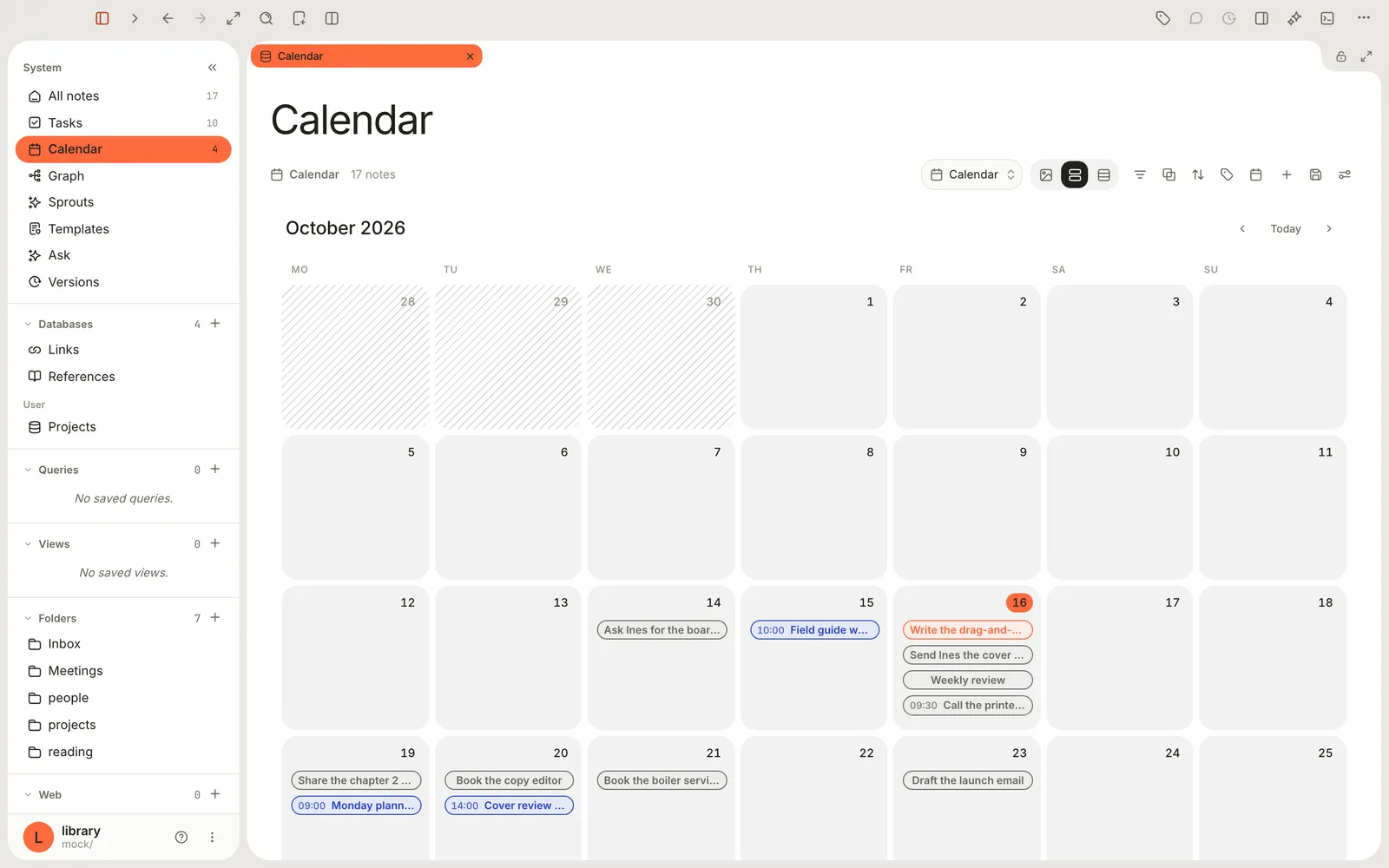
The Calendar lays your Library out by date. Meetings appear by their start time and tasks by their due date, and dragging one reschedules it.
The Calendar is a built-in view of your Library by date. A note appears on the day in its start-time property, which suits meetings and appointments, and a task appears on its due date. Nothing is copied: each item on the Calendar is the note or the task line, so moving it to another day changes the date in the note.
Click Calendar in the sidebar to open it.
What shows up
| Item | What puts it on the Calendar | How it looks |
|---|---|---|
| A note | A date in its start-time property | The title, after the start time. A date with no time makes it an all-day item. |
| A task | A due= date on its line | The title, outlined in its status colour, after the time if the due date has one |
Everything else stays off the Calendar: notes without start-time, tasks without a due date. Tasks appear whatever their status, so finished ones stay on their day as a record.
Events from Google Calendar can't be shown yet. Settings › Integrations lists Google Calendar as Coming soon.
Put a note on the Calendar
There's no button for creating an event on the Calendar itself. A meeting is a note with a start time:
- Open the note, or create one. The Meeting template is a good start (see Take meeting notes).
- Under the note's properties, click + (Add property), choose Existing property, then
start-time. - Pick the date and time.
- For a meeting with a length, add
end-timethe same way, then set the Calendar's End as described in Choose the dates it uses.
In the note's file they're ordinary properties, with values such as 2026-10-20T14:00.
To put a task on the Calendar, give it a due date: ::: due=2026-10-20. See Task syntax.
Open, change and reschedule
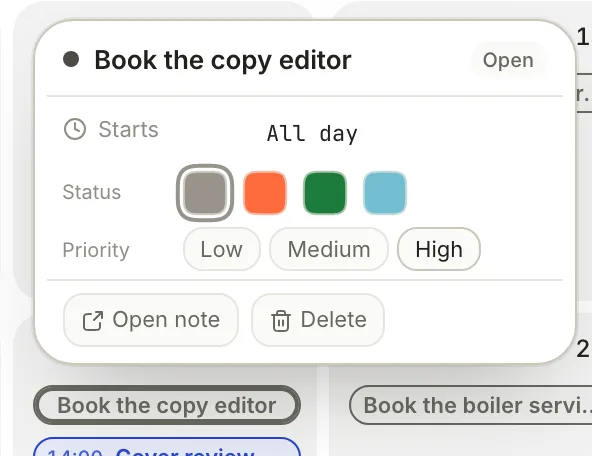
- Click an item for a small card. A task's card has its status colours, Low, Medium and High priority buttons, Open note and Delete. A note's card shows its start and end, a few lines of the note, Open note and Delete.
- Drag an item to another day to reschedule it. A task gets a new
due=; a note gets a newstart-time(andend-time, moved by the same amount). The time of day stays the same. - Move between months with the arrows beside Today, and click Today to come back.
A day shows up to four items. When there are more, it says +2 more (or however many); open the day's notes from Tasks or the Calendar drawer instead, because the label can't be clicked yet.
Display modes
The Display mode menu in the header lists Month, Week, Day and Agenda. In this version the built-in Calendar always shows the month grid: picking another mode there doesn't change it. The other modes work in calendars you make yourself; see Calendars of your own.
Choose the dates it uses
By default the Calendar places notes by start-time and gives them no end. To use other properties, or to show meeting lengths:
- In the Calendar's header, click View preferences (the sliders at the far right).
- Click Dates.
- Pick a property for Start and one for End. Most people only set End to
end-time.
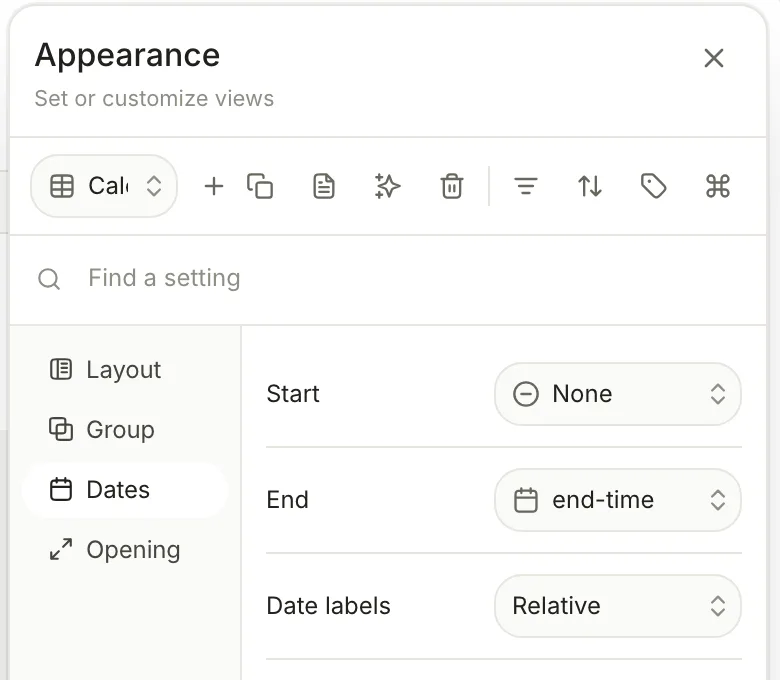
Any date property works, for example a deadline property on your project notes. These choices are saved for the whole Library.
The Calendar drawer
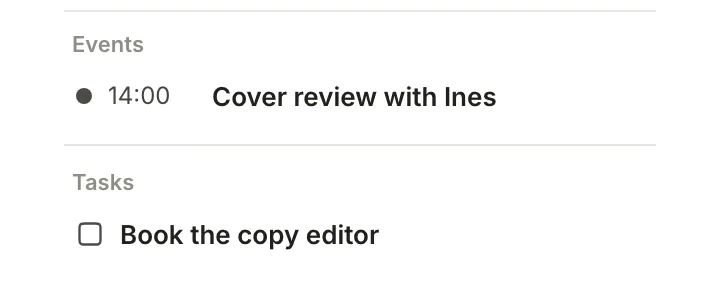
To see one day beside whatever you're working on, click Properties in the toolbar (⌘R) to open the panel on the right, then click Show Calendar in the row of buttons along its bottom. The drawer has a small month with a dot under each busy day. Click a day to list its Events (notes with both a start-time and an end-time) and its Tasks.
You can also hover the number beside Calendar in the sidebar to list the events for Today, This week or This month.
Calendars of your own
The built-in Calendar shows the whole Library. For a calendar of your own, right-click Calendar in the sidebar, choose New calendar database, give it a name and click Create. It appears under Calendar, uses the same start and end properties, and starts with every note; use Filters in its header to narrow it, for example to the Meetings folder (see Filter, sort and group). Here, Display mode switches between Month, Week, Day and Agenda, which lists the next two weeks.
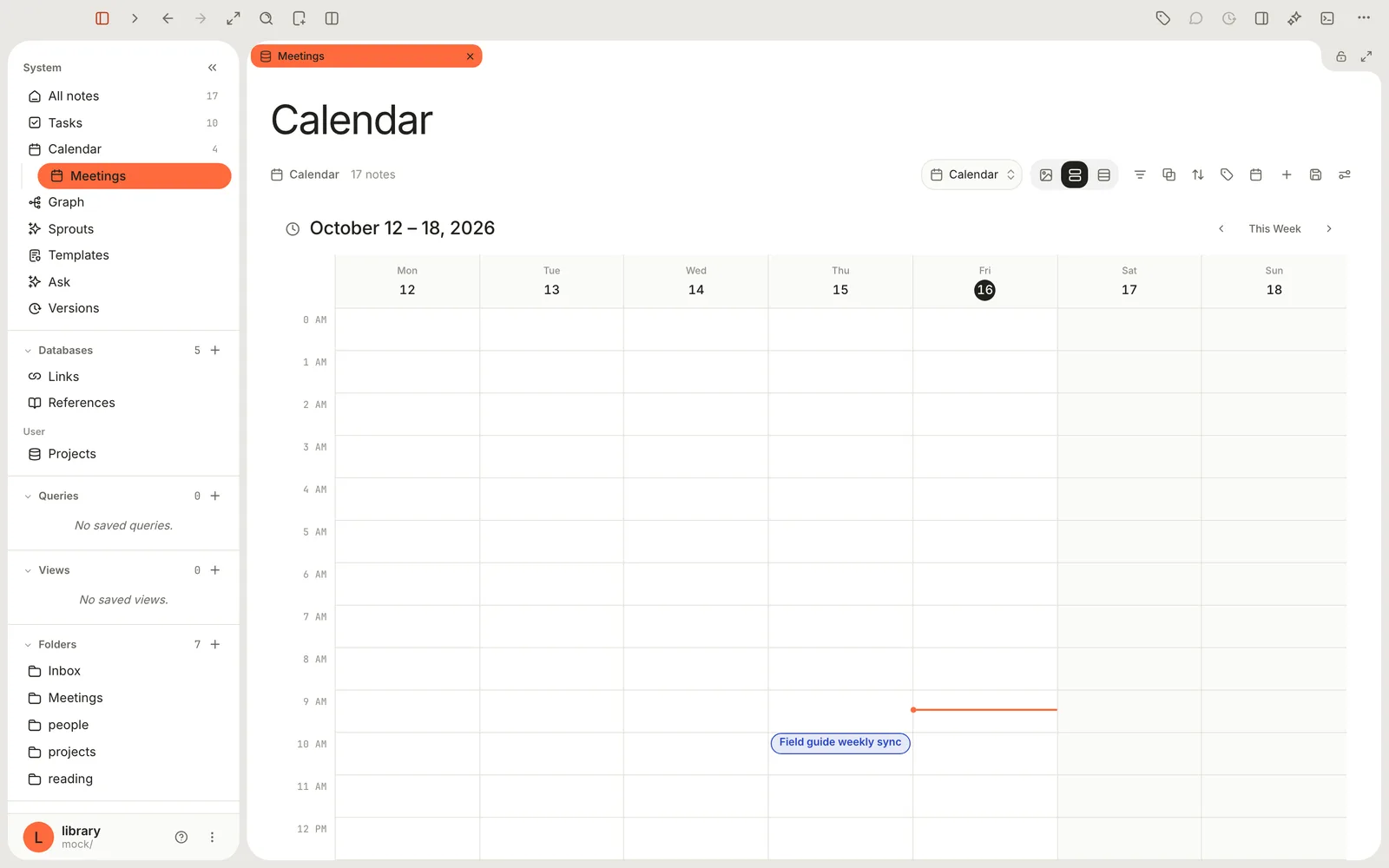
A calendar of your own shows notes only: tasks appear on the built-in Calendar. Any database can also be shown as a calendar by choosing the Calendar layout for one of its views; see Views and layouts.
Week start and time zone
The Calendar's weeks always start on Monday, and times are shown in your Mac's time zone. Settings › General has Week starts and Timezone, but they don't change the Calendar: they're for weekly groups in databases, date pickers, scheduled reports and logs.
Daily notes
Terra has no daily-note button that opens today's page. The Daily log template (File › New from Template…, ⇧⌘N) makes a page headed with today's date, with Wins, Blockers and Tomorrow sections. Like any note, it appears on the Calendar only if you give it a start-time.
Troubleshooting
My meeting note isn't on the Calendar
It needs a start-time property. Writing the date in the text, as the Meeting template does, isn't enough. If you've changed View preferences › Dates › Start, the note needs that property instead.
My meetings show as a single time, not a block
Set End to end-time under View preferences › Dates, and give the note an end-time later than its start-time.
A note without a time shows up a day early
In this version, a note whose start is a date with no time can land on the day before in time zones behind UTC, such as the Americas. Tasks aren't affected. Give the note a time, even 09:00, and it lands on the right day.
I picked Week but still see the month
On the built-in Calendar, Display mode has no effect in this version. Use the Calendar drawer for one day, or make a calendar database of your own for Week, Day and Agenda.
Related
- Tasks — due dates, statuses and the board.
- Take meeting notes that turn into tasks — meetings on the Calendar, action items in Tasks.
- Run your week with tasks and the calendar — a weekly routine.
- Views and layouts — the Calendar layout for any database.
Was this guide helpful?