# Keyboard shortcuts
> Every default shortcut in Terra, grouped the way Settings › Hotkeys groups them, and how to change, reset or remove one.
Source: https://terramd.io/docs/keyboard-shortcuts
These are Terra's default shortcuts. To see them in the app, and to change them, open **Settings › Hotkeys**: press ⌘ , and click **Hotkeys**, or choose **Help › Keyboard Shortcuts**. The groups below follow the same order.
Keys are shown in the order macOS uses: ⌃ Control, ⌥ Option, ⇧ Shift, ⌘ Command. Where a command has more than one shortcut, any of them works.
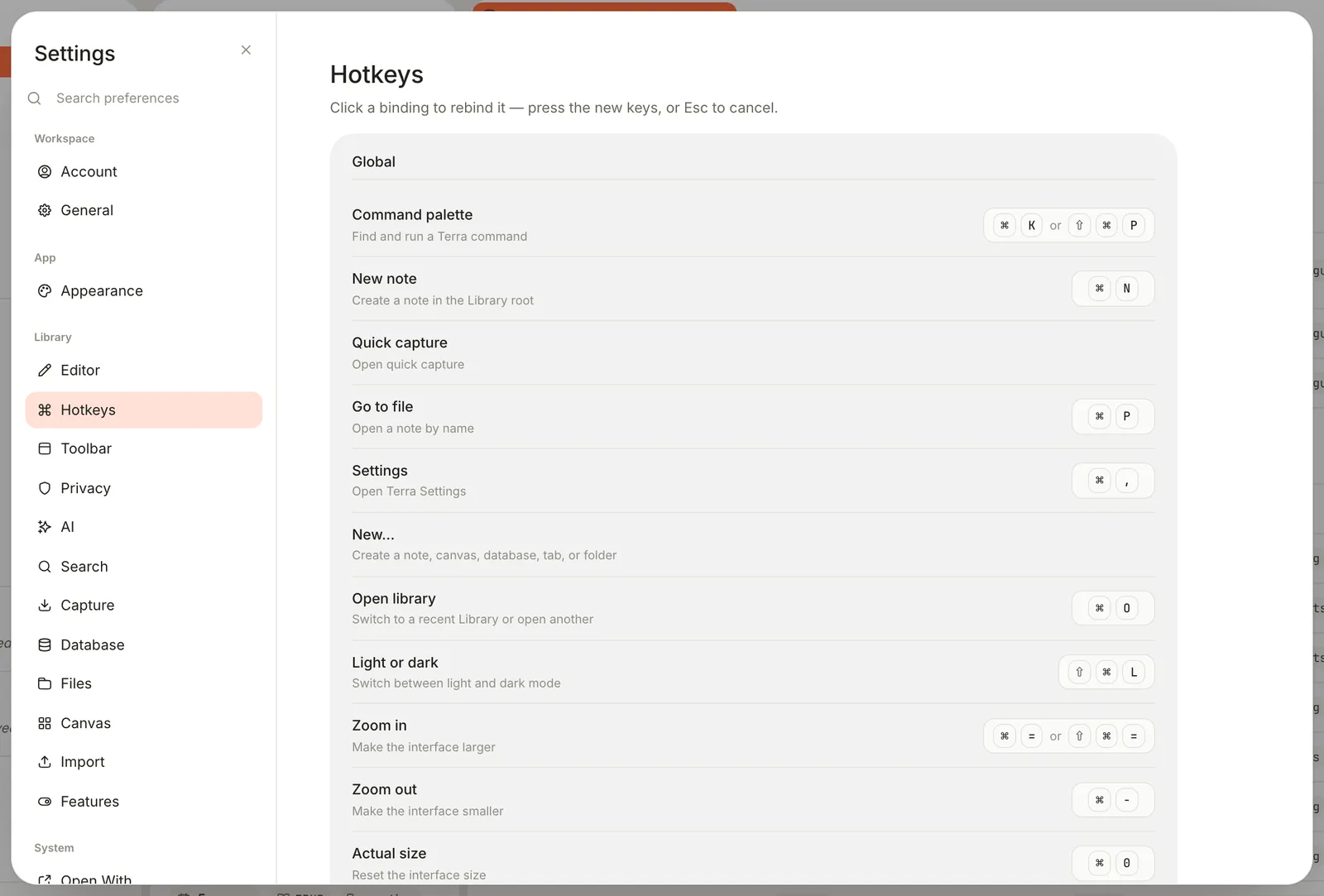
## Global
| Action | Shortcut |
| --- | --- |
| Command palette | ⌘ K or ⇧ ⌘ P |
| New note | ⌘ N |
| Go to file (open a note by name) | ⌘ P |
| Settings | ⌘ , |
| Open library (switch to another Library) | ⌘ O |
| Light or dark | ⇧ ⌘ L |
| Zoom in (make the interface larger) | ⌘ = or ⇧ ⌘ = |
| Zoom out | ⌘ - |
| Actual size | ⌘ 0 |
| Close window | ⇧ ⌘ W |
No keys by default: **Quick capture** and **New…**. Separately, ⌃ ⌥ ⌘ N opens quick capture from any app, even when Terra is in the background. That one isn't listed in Settings › Hotkeys.
## Navigation
| Action | Shortcut |
| --- | --- |
| Sidebar (show or hide) | ⌘ B |
| Properties (show or hide the panel on the right) | ⌘ R or ⌥ ⌘ B |
| Search | ⇧ ⌘ F |
| Toggle view mode (Edit or Read) | ⌥ ⌘ E |
| Cycle database layout | ⇧ ⌘ V |
| Zen mode | ⌥ ⌘ Z |
| Terminal | ⌘ J |
| Back | ⌘ [ |
| Forward | ⌘ ] |
| Reveal in sidebar (show the open note's folder) | ⇧ ⌘ E |
No keys by default: **Database drawer**, **Comments**, **Versions**, **AI conversations**, **Source mode** and **Reader mode**.
With text selected in a note, ⌘ B makes it bold instead of hiding the sidebar.
## Panes and tabs
| Action | Shortcut |
| --- | --- |
| Split (open a second pane to the right) | ⌘ \ |
| Previous pane | ⌃ ⌥ ← |
| Next pane | ⌃ ⌥ → |
| Close tab | ⌘ W |
| Reopen closed tab | ⇧ ⌘ T |
| Next tab | ⇧ ⌘ ] or ⌥ ⌘ → or ⌃ Tab |
| Previous tab | ⇧ ⌘ [ or ⌥ ⌘ ← or ⌃ ⇧ Tab |
| Focus pane 1 to 9, in reading order | ⌘ 1 to ⌘ 9 |
| Tab 1 to 9 of the focused pane | ⌃ 1 to ⌃ 9 |
| Last tab of the focused pane | ⌃ 0 |
- ⌘ W closes the tab you're in, and a pane closes with its last tab. With only one tab left in the window, it closes the window.
- A window holds up to four panes, so only ⌘ 1 to ⌘ 4 ever have a pane to go to. Previous pane and Next pane stop at the first and last pane rather than wrapping around.
- ⇧ ⌘ T remembers the last 20 tabs you closed, until you quit.
## Editor
| Action | Shortcut |
| --- | --- |
| Save (Terra also saves as you type) | ⌘ S |
| Duplicate (the selected block, or the open note) | ⌘ D |
| Find in page | ⌘ F |
| Redo | ⌘ Y |
| Copy link to note (a `terra://` link to the open note) | ⌘ L |
| Comment (opens the note's comments) | ⇧ ⌘ M |
No keys by default: **Slash commands** and **Reload theme**.
## Other
| Action | Shortcut |
| --- | --- |
| Side by side (two panes) | ⌃ ⌥ 1 |
| 60 / 40 (two panes, the first wider) | ⌃ ⌥ 2 |
| Stacked (two panes, one above the other) | ⌃ ⌥ 3 |
| Three columns | ⌃ ⌥ 4 |
| Main + two (one main pane, two stacked beside it) | ⌃ ⌥ 5 |
| 2 × 2 (four panes) | ⌃ ⌥ 6 |
A layout rearranges the panes you already have, so each one works only with that many panes open. No keys by default: **Tag manager**, **Property manager** and **Help**.
## Reader
These work while a book is open in the [e-reader](https://terramd.io/docs/read-in-the-e-reader) and the page has focus. Click the page first.
| Action | Shortcut |
| --- | --- |
| Previous page | ← or Page Up or ⇧ Space |
| Next page | → or Page Down or Space |
| Previous chapter | ⇧ ⌘ ← or ⌘ Page Up |
| Next chapter | ⇧ ⌘ → or ⌘ Page Down |
| Beginning of book | ⌘ Home |
| End of book | ⌘ End |
| Back (to where you were reading) | ⌘ ⌫ |
| Forward | ⇧ ⌘ ⌫ |
| Bookmark page | ⌘ B |
| Named bookmark | ⌥ ⇧ B |
| Highlight with note | ⌥ ⇧ A |
| Quick highlight | ⌥ ⇧ Q |
| Annotations in margin | ⌥ ⇧ ⌘ Z |
| Go to page | ⇧ ⌘ P |
| Zoom in | ⌘ 9 |
| Zoom out | ⌘ 8 |
| Fit page | ⌘ 0 |
Zoom in, Zoom out and Fit page apply to fixed-layout books, whose pages are laid out like a PDF. Go to page needs a book that lists its print pages.
## Keys in notes, code, sheets and the sidebar
Settings › Hotkeys lists these too, as a reference. They belong to the part of the window you're working in, so you can't change them.
### Undo
| Action | Shortcut |
| --- | --- |
| Undo | ⌘ Z |
| Redo | ⇧ ⌘ Z |
Outside a text field, ⌘ Z also brings back the last note you moved to the Trash.
### Text
While you're writing in a note:
| Action | Shortcut |
| --- | --- |
| Bold (with text selected) | ⌘ B |
| Italic | ⌘ I |
| Underline, while you edit only: Markdown has no underline, so it isn't saved to the file | ⌘ U |
| Strikethrough | ⇧ ⌘ S |
| Inline code | ⌘ E |
| Add a link (with text selected) | ⌘ K |
| Turn into… (choose a new block type) | ⌘ / |
| Turn into text | ⌥ ⌘ 0 |
| Turn into heading 1 | ⌥ ⌘ 1 |
| Turn into heading 2 | ⌥ ⌘ 2 |
| Turn into heading 3 | ⌥ ⌘ 3 |
| Turn into to-do | ⌥ ⌘ 4 |
| Turn into bulleted list | ⌥ ⌘ 5 |
| Turn into numbered list | ⌥ ⌘ 6 |
| Turn into toggle (a block you can fold) | ⌥ ⌘ 7 |
| Turn into code | ⌥ ⌘ 8 |
| Turn into page (move the block to a new note, and link to it) | ⌥ ⌘ 9 |
| Indent a list item or to-do | Tab |
| Outdent a list item or to-do | ⇧ Tab |
| Move block up | ⌥ ↑ |
| Move block down | ⌥ ↓ |
| Duplicate block up | ⌥ ⇧ ↑ |
| Duplicate block down | ⌥ ⇧ ↓ |
| Duplicate block | ⌘ D |
| Delete block | ⇧ ⌘ K |
| Check a to-do, or open or close a toggle | ⌘ Return |
| Expand or collapse all toggles | ⌥ ⌘ T |
| Select the current block | Esc |
| Show or hide the outline beside the note | ⇧ ⌘ O |
### Code
With the cursor in a code block:
| Action | Shortcut |
| --- | --- |
| Comment line | ⌘ / |
| Indent line | ⌘ ] |
| Outdent line | ⌘ [ |
| Select line | ⌘ L |
| Select next match | ⌘ D |
| Move line up | ⌥ ↑ |
| Move line down | ⌥ ↓ |
| Delete line | ⇧ ⌘ K |
| Toggle line numbers | ⌘ ; |
| Format (needs a formatter installed on your Mac) | ⇧ ⌘ I |
| Convert code block to text | ⌘ E |
### Sheets and databases
In a sheet, with several cells selected:
| Action | Shortcut |
| --- | --- |
| Fill down | ⌘ D |
| Fill right | ⌘ R |
### Peek
While a note is open in a peek:
| Action | Shortcut |
| --- | --- |
| Previous row of the list it came from | ⌃ ⇧ K |
| Next row | ⌃ ⇧ J |
### Sidebar
With a folder selected in the sidebar:
| Action | Shortcut |
| --- | --- |
| Rename | F2 |
| New folder | ⌥ ⌘ N |
| Copy absolute path | ⌥ ⌘ C |
| Copy relative path (from the Library folder) | ⌥ ⇧ ⌘ C |
| Reveal in Finder | ⌥ ⌘ R |
| Move to Trash | ⌘ ⌫ |
## More keys
A few keys aren't in Settings at all:
| Action | Shortcut |
| --- | --- |
| Flip a split between side by side and stacked | ⇧ ⌘ \ |
| Open a note in a new tab | ⌘-click it in any list |
| Restore a maximized pane, close a peek, or close a menu or dialog | Esc |
| Nest or un-nest the selected blocks | ⌥ ⇧ → or ⌥ ⇧ ← |
| Back and forward | swipe left or right with two fingers, or use your mouse's back and forward buttons |
| Move a toolbar button earlier or later, while customizing the toolbar | ⌥ ← or ⌥ → |
| Hide a toolbar button, while customizing the toolbar | ⌫ |
## Markdown as you type
In a note, typing Markdown marks formats the text straight away. A few of the most used:
| Type | To get |
| --- | --- |
| `#` to `######`, then a space, at the start of a line | Heading 1 to 6 |
| `-` or `*`, then a space | Bullet list |
| `1.`, then a space | Numbered list |
| `[ ]`, then a space | To-do |
| `>`, then a space | Quote |
| ```` ``` ```` (with an optional language, such as ```` ```python ````), then a space | Code block |
| `---` | Divider |
| `**bold**`, `*italic*`, `~~struck~~`, `` `code` ``, `==highlighted==` | Bold, italic, strikethrough, inline code, highlight |
| `/` | The menu of blocks to insert |
| `@` | A menu to link a note or cite a source; on a to-do line, to add a date too |
[Basic formatting syntax](https://terramd.io/docs/formatting-syntax) shows each one with what it saves in the file, and [Advanced formatting](https://terramd.io/docs/advanced-formatting) covers tables, math and the rest.
## Change a shortcut
You can give any command in the Global, Navigation, Panes and tabs, Editor, Other and Reader groups new keys, including commands that have none.
1. Press ⌘ , to open **Settings**, then click **Hotkeys**. (**Help › Keyboard Shortcuts** goes straight there.)
2. Click the keys beside a command. They change to **Press keys…**.
3. Press the new keys. To back out, press Esc.

To undo a change, hover over the command and click **Reset to default** (the curved arrow). To remove a shortcut without replacing it, hover and click **Unbind** (**×**).
Good to know:
- New keys replace all of a command's shortcuts. Command palette has two by default, ⌘ K and ⇧ ⌘ P; after a change it has only the one you pressed. **Reset to default** brings both back.
- Terra doesn't warn you when two commands share the same keys, and only one of them will run. Check the list for the keys before you use them.
- Shortcuts belong to the Library that's open, so each Library can have its own.
- The menu bar keeps showing the default keys, and its items still respond to them.
- A shortcut without ⌘ or ⌃ doesn't fire while you're typing in a note or a text field.
## Related
- [Make Terra yours](https://terramd.io/docs/make-terra-yours): the toolbar, themes and the rest of Settings.
- [Find your way around](https://terramd.io/docs/find-your-way-around): what each pane, panel and drawer is.
- [Basic formatting syntax](https://terramd.io/docs/formatting-syntax): what to type for each kind of formatting.
- [Search syntax](https://terramd.io/docs/search-syntax): what you can type in the search window.